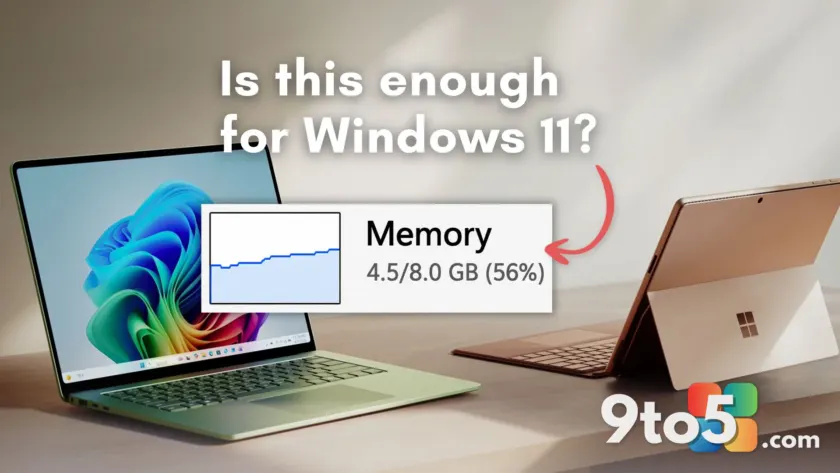
For two years, Microsoft made a consistent case that 16GB of RAM was the non-negotiable starting point for a smooth Windows 11 experience. That narrative has officially changed. The company’s Surface buying guide now describes 8GB of RAM as “great for everyday use like browsing, streaming, schoolwork, and productivity apps.”
This marks a significant pivot from recent months, where Microsoft aggressively pushed higher memory configurations to support its Copilot+ PC initiative. The update suggests the company is recalibrating its hardware expectations in response to market realities and consumer pushback.
The rapid reversal on RAM recommendations
Just a few months ago, Microsoft’s stance was much more demanding. In February 2026, the company stated that 32GB of RAM was ideal for serious PC gamers on Windows 11. By May, a separate blog post went further, labeling 32GB the “no worries” upgrade for gaming. That specific recommendation faced swift backlash from users who found it out of touch with current pricing and availability, leading Microsoft to quietly delete the post.
Even before the 32GB controversy, Microsoft had been vocal about the limitations of lower-memory devices. When Apple launched the $599 MacBook Neo with 8GB of RAM earlier this year, Microsoft commissioned a report from Signal65 arguing that Windows 11 laptops offered better value because they typically came with 16GB. The report explicitly cited Apple’s 8GB configuration as a bottleneck.
Now, the company’s own product pages tell a different story. While the Surface store guide validates 8GB for daily tasks, Microsoft’s AI store assistant hedges its bets. When asked if 8GB is enough in 2026, the chatbot calls 16GB the “safer choice” for users who want their laptop to feel “future proof.” This inconsistency highlights the internal tension between marketing high-end Copilot+ features and selling budget-friendly hardware.
Why the shift? The Copilot+ PC slowdown
The retreat from the 16GB baseline appears linked to the underperformance of the Copilot+ PC branding. Microsoft invested heavily in creating a new hardware tier defined by Neural Processing Units (NPUs) and high memory requirements, aiming to drive an upgrade cycle around AI features.
However, the initiative has lost steam. The company dropped the Copilot+ PC branding from press materials for its new NVIDIA-powered Surface Laptop Ultra, despite the device technically qualifying. Furthermore, internal confidence in Copilot’s competitive edge has waned; a former Microsoft VP recently suggested the company missed the AI wave, similar to how it missed the mobile transition. With Windows 11 pulling back on some AI features that failed to meet expectations, the hardware justification for mandatory 16GB+ RAM has weakened.
Budget Surface models lead the way
The practical application of this new policy is visible in Microsoft’s latest hardware lineup. The consumer Surface Laptop 13 and Surface Pro 12 now start with 8GB of RAM. These devices utilize last-generation Snapdragon X chips, positioning them as more affordable entry points.
Critics note that these configurations present a value problem: the price for an 8GB model today is often higher than what customers paid for 16GB versions of similar hardware a year ago. This pricing structure suggests Microsoft is trying to maintain premium margins while lowering spec bars, rather than offering genuine budget relief.
For everyday users, this means you can technically buy a new Surface with 8GB and expect it to handle web browsing and Office apps without immediate issues. However, if you plan to use advanced Copilot+ features, Microsoft’s own FAQ clarifies that 16GB or more is required to unlock those capabilities.
What this means for you
If you are shopping for a new Windows 11 PC, the message is mixed. For light users who primarily browse the web, watch videos, and use standard productivity apps, 8GB is officially deemed sufficient by Microsoft. This could make entry-level devices more attractive if prices drop to match the specs.
However, caution is advised. Windows 11 remains a heavy operating system, especially with modern web browsers and Electron-based apps like Teams or Discord consuming significant resources. Additionally, RAM prices have risen due to global supply chain shifts driven by AI data center demand. If you can afford the upgrade, 16GB still offers a more comfortable buffer for multitasking and future software updates. The 8GB recommendation is likely a compromise between cost constraints and performance realities, not an endorsement of optimal performance.
Source: Windows Latest
Over to you: Will you stick with 8GB for basic tasks, or is 16GB still your minimum requirement for a new Windows 11 PC?