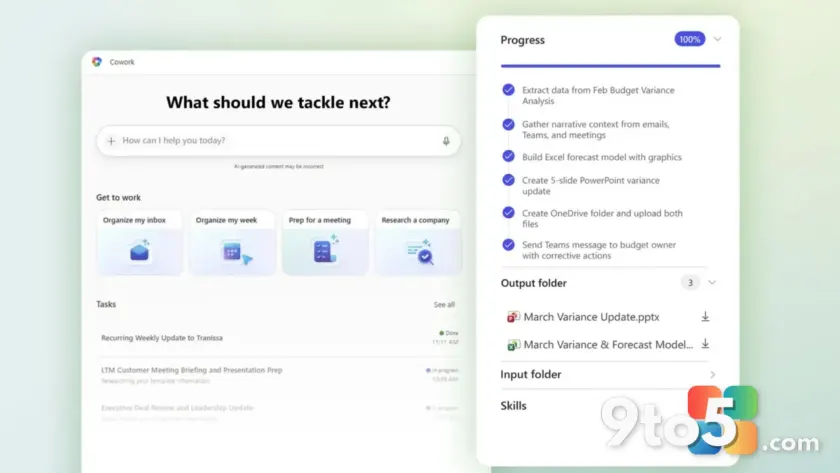
Microsoft has officially moved its Copilot Cowork platform out of preview, marking a significant step in its strategy to deploy autonomous AI agents within enterprise environments. The service, designed to handle complex, multi-step business processes, is now generally available for organizations looking to integrate AI directly into their operational workflows.
Key Capabilities and Integrations
At the core of Copilot Cowork is the ability to execute long-running workflows from start to finish without constant human intervention. This distinguishes it from standard chat-based assistants by allowing the agent to manage tasks that span across different applications and timeframes.
The platform also emphasizes deep integration with popular third-party plugins. By connecting with existing enterprise software, Copilot Cowork can act as a bridge between disparate systems, automating data transfer and process execution based on natural language commands.
Usage-Based Billing
Alongside the general availability launch, Microsoft has introduced a usage-based billing model. This approach allows enterprises to pay for the specific compute resources and AI interactions they consume, rather than relying solely on fixed subscription tiers. This flexibility aims to reduce upfront costs for organizations testing the technology or those with variable workload demands.
What this means for you
For IT administrators and business leaders, this availability signals that Microsoft is treating AI agents as a core infrastructure component rather than an experimental feature. The shift to usage-based pricing lowers the barrier to entry for pilot programs, allowing teams to experiment with automating repetitive administrative tasks without committing to large-scale licenses immediately.
As the platform matures, users can expect to see more specialized agents designed for specific industries, potentially reducing the manual burden of cross-platform data management and workflow coordination.
Source: Neowin