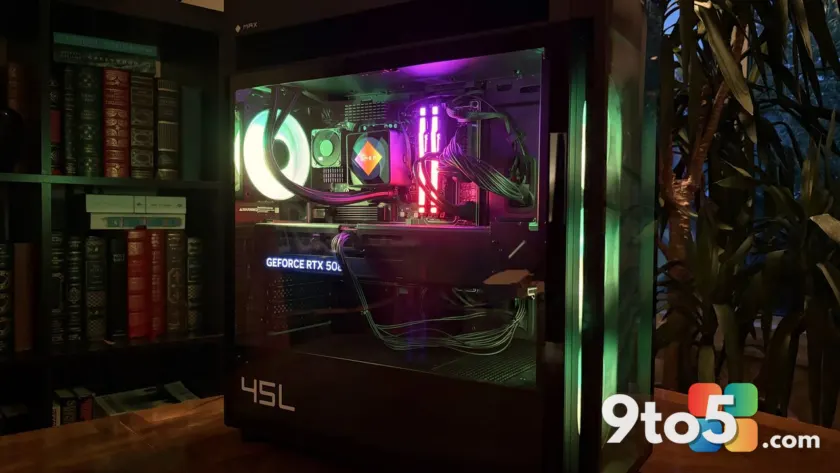
High-end pre-built gaming PCs have historically struggled to justify their price premiums over custom builds. You typically pay for assembly, warranty, and brand name, often at the cost of proprietary parts and mediocre cable management. HP’s latest attempt to change that narrative is the Omen Max 45L, a flagship desktop that arrives with a distinct engineering approach to thermals and a configuration capable of pushing the absolute limits of modern gaming.
After spending two weeks living with the system in a daily driver capacity, it is clear that HP has made specific design choices aimed at enthusiasts who prioritize acoustics and thermal headroom above all else. The system relies on a dedicated air-gapped compartment for its liquid cooling radiator, a custom motherboard layout, and a power supply that includes a unique dust-cleaning feature. However, the execution of the chassis assembly and the software experience present some friction points that potential buyers should weigh against the raw performance.
This HP Omen Max 45L review breaks down exactly what the system offers, how it performs under sustained loads, and whether the engineering innovations actually translate to a better experience for the end user.
What You Get Inside the HP Omen Max 45L
HP has structured the Omen Max 45L into clear tiers, with pricing that reflects the current market reality for high-performance components. The entry-level configuration starts at $3,489.99, featuring an AMD Ryzen 7 9700X processor, an NVIDIA RTX 5070 GPU, 32GB of Kingston Fury DDR5-6000 memory, and a 1TB M.2 PCIe 4.0 NVMe SSD. At the top of the lineup, HP offers a configuration priced at $6,499.99, which includes an AMD Ryzen 9 990X3D processor, an NVIDIA RTX 5090 GPU, 64GB of DDR5 RAM, and 4TB of storage.
The specific unit evaluated for this review sits near the upper end of the spectrum. Before discounts, the list price is $5,959.99, though HP has currently reduced it to $5,159.99. The configuration tested includes an AMD Ryzen 9 9950X3D processor paired with a custom NVIDIA RTX 5080 GPU. Memory consists of 64GB of DDR5-6000 Kingston Fury Beast RGB sticks, while storage is handled by a 2TB Samsung PM9A1 M.2 PCIe 4.0 NVMe drive.
The foundation of the system is a custom micro-ATX motherboard built around the AMD X870 chipset. This board is designated as the HP 8E55 and is designed to fit within the chassis while leaving room for a full-size ATX board if users wish to upgrade later. The power delivery is managed by a 1200W unit that carries a Cybenetics Platinum efficiency rating and adheres to the ATX 3.1 standard. Wireless connectivity is provided by either a Wi-Fi 6E or Wi-Fi 7 module, paired with Bluetooth 5.3 or 5.4, depending on the specific configuration chosen.
To understand the value proposition, it is useful to compare this system against a hypothetical custom build. Using current component pricing, a DIY build featuring the same CPU, GPU, RAM, storage, PSU, X870 motherboard, Windows 11 license, and a comparable Lian Li O11 case would cost approximately $4,616. Adding high-quality ARGB case fans would push that total to roughly $4,800 to $5,000. This means that without the current discount, HP is charging a significant premium for the assembled system, a gap that narrows considerably when promotional pricing is applied.
The Cryo Chamber Cooling System
The most distinct engineering feature of the Omen Max 45L is the Cryo Chamber. Rather than mounting the all-in-one CPU cooler’s radiator inside the main chassis where it would compete with the GPU for intake air, HP has isolated the radiator in a separate, air-gapped compartment at the top of the case. This section is physically separated from the rest of the internal volume, meaning the fans push hot air directly out of the system without recirculating it over the graphics card or motherboard components.
This design choice addresses a common issue in high-density gaming PCs: thermal throttling caused by GPU exhaust heat being pulled back over the CPU cooler. By keeping the cooling loop entirely external to the main airflow path, HP ensures that the radiator operates on clean, ambient-temperature air. The trade-off for this efficiency is physical size. The Omen Max 45L measures 8.03 x 18.15 x 21.85 inches and weighs nearly 50 pounds. Users with limited desk or shelf space will need to verify clearance before purchasing.
Thermal performance was measured using a prolonged 3DMark Speed Way stress test. With all panels, including the front glass, securely in place, the AMD Ryzen 9 9950X3D maintained a temperature of 46 degrees Celsius. The custom RTX 5080 GPU reached 75 degrees Celsius under the same load. When the front glass panel was removed to simulate maximum airflow, GPU temperatures dropped marginally to 74 degrees Celsius, while the CPU temperature remained unchanged due to the isolated cooling design.
Acoustics are a notable strength of this configuration. During the most intensive stress testing, the system peaked at 47 decibels. For context, this is quieter than many competing pre-built systems under full load, and the noise profile remains unobtrusive during standard gaming sessions. The isolation provided by the Cryo Chamber appears to allow the radiator fans to operate at lower RPMs while still dissipating the heat generated by the flagship processor and GPU.
Build Quality and Port Selection
Physical access to the interior of the Omen Max 45L is straightforward. HP has designed the chassis with quick-release side and front panels, as well as a pull-off top section that provides direct access to the AiO radiator without the need for tools. A removable dust screen covers the three front intake fans, a practical feature for users who operate their systems in environments with pets or high dust levels. After two weeks of testing, the internal components showed minimal dust accumulation, indicating the filtration system is effective.
The RTX 5080 GPU is secured with an additional bracket that prevents sag and eliminates the need for foam packing material during shipping. The system booted successfully on the first power press, with no post-installation adjustments required for the hardware. However, the overall assembly quality presents a mixed experience. The CPU pump header was not mounted perfectly square on the cold plate, and the front panel exhibits a slight misalignment on one side. The rear side panel also requires careful alignment to sit flush with the chassis frame.
Cable management is the most significant weakness of the build. On the visible side of the chassis, loose cables and excess length create a cluttered appearance that detracts from the premium positioning of the system. More critically, the cabling behind the rear metal panel is disorganized. Compared to competitors like the Maingear MG-1 MK.II or the Acer Nitro 65, the hidden wiring in the Omen Max 45L lacks the tidy routing expected at this price point. A bundle of cables is pinched between the panel and the motherboard backing, and another cluster sits directly in front of the modular power supply. HP does include correctly sized SATA cables positioned near the dual empty HDD bays, which simplifies future storage additions.
Connectivity options are functional but conservative. The front I/O panel provides two USB-A ports rated at 5Gbps, one USB-C port at 10Gbps, and a 3.5mm audio combo jack. The rear of the custom micro-ATX motherboard offers four USB-A 2.0 ports, two USB-A 5Gbps ports, and two USB-C 10Gbps ports. Wired networking is handled by a 2.5Gb Ethernet port, accompanied by dedicated line-in, line-out, and microphone jacks. The GPU configuration includes one HDMI 2.1b port and three DisplayPort 2.1b outputs. The rear I/O panel leaves several mounting holes unused, suggesting potential for future expansion that HP did not populate at the factory.
Performance and Software Experience
Performance validation was conducted using standard industry benchmarks. The custom RTX 5080 achieved a score of 8,996 in 3DMark’s Speed Way test and 8,628 in Steel Nomad. These results align with expected performance for an RTX 5080 variant, confirming that the custom cooling and power delivery do not hinder the GPU’s capabilities. The AMD Ryzen 9 9950X3D processor performed consistently with baseline expectations for multi-threaded workloads.
For users whose primary use case is gaming, the Ryzen 7 9800X3D may offer a more efficient value proposition. It delivers comparable gaming performance while costing approximately $330 less than the 9950X3D, allowing those savings to be redirected toward other components or peripherals. The Samsung PM9A1 storage drive delivered read speeds of 6,626 MB/s and write speeds of 4,993 MB/s. While these figures are competitive for PCIe 4.0 drives, they do not represent the absolute fastest storage available in the current market.
The 1200W power supply stands out as a positive element in an otherwise mixed hardware review. It carries a Cybenetics Platinum efficiency certification, operates quietly, and features a fully modular cable design. A unique inclusion is the reverse fan cleaning tool, which spins the PSU fan in reverse to eject accumulated dust without requiring the user to open the case. This maintenance feature is rarely found in pre-built systems and adds practical long-term value.
Software management is handled through HP’s Omen Gaming Hub. While the application provides necessary controls for system monitoring and performance profiles, it displays advertisements within the interface, which is an unwelcome intrusion on a system of this price point. Additionally, the RGB lighting firmware exhibits instability, with ARGB effects occasionally resetting or failing to respond until a full system restart. HP also preinstalls a substantial amount of third-party software, including McAfee antivirus, Adobe offers, Booking.com, and seven distinct HP applications. While all of this bloatware can be removed, competitors in the high-end pre-built space increasingly ship with clean installations of Windows 11, setting a standard that HP has not yet matched.
What This Means for You
The HP Omen Max 45L represents a specific philosophy in high-end desktop design. HP has prioritized thermal isolation and acoustic performance through the Cryo Chamber, resulting in a system that runs cooler and quieter than many direct competitors. The inclusion of a Platinum-rated power supply with a dust-cleaning feature and the use of standard-sized components for future upgrades further demonstrate an awareness of enthusiast needs.
However, the premium pricing and inconsistent assembly quality create friction. The cable management issues are noticeable both inside and outside the chassis, and the software experience lags behind industry standards for clean, ad-free operation. Users who value raw performance and thermal efficiency above all else will find the hardware capable of delivering flagship results. Those who prioritize pristine build quality, tidy cabling, and a polished software experience may find better alignment with boutique custom builders who charge similar prices.
How to Get the HP Omen Max 45L
The HP Omen Max 45L is available for direct purchase through HP’s official website. Configurations start at $3,489.99 for the entry-level model and extend up to $6,499.99 for the fully loaded RTX 5090 variant. HP frequently rotates promotional discounts, so checking the current pricing before finalizing an order is recommended. The system ships with a standard one-year warranty, with extended HP Care Pack options available for purchase separately.
Source: Latest from Windows Central
Over to you: Does the isolated Cryo Chamber cooling justify the premium over a custom build for you?