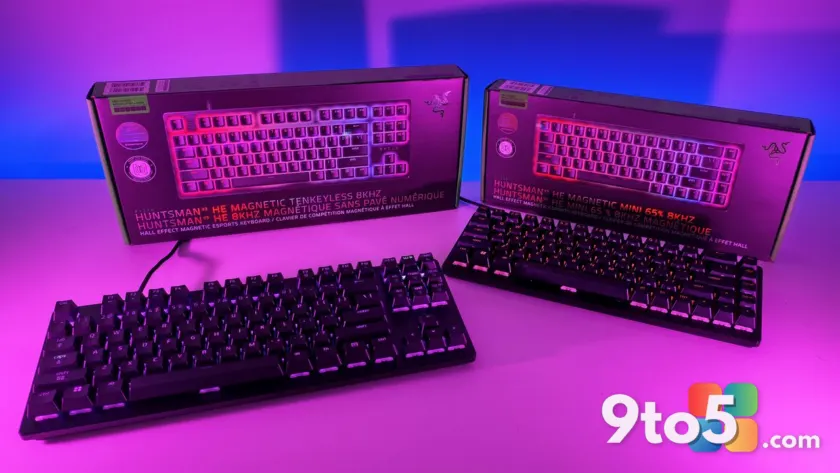
Magnetic keyboards have long occupied a niche within the peripheral market, often reserved for enthusiasts willing to navigate boutique brands and uncertain firmware support. Razer has now entered this space with its first Hall Effect magnetic Huntsman keyboards, signaling a shift toward mainstream adoption of this technology. The new lineup includes the Razer Huntsman V3 HE Magnetic Tenkeyless and the Huntsman V3 HE Magnetic Mini 65%, both designed to deliver precision and configurability without the typical compromises of early magnetic switch adoption.
After evaluating both models, the consensus is that Razer is treating magnetic switches as a serious priority. The boards retain the familiar Huntsman aesthetic while integrating advanced sensing capabilities. This approach makes the technology significantly more accessible to general players who might otherwise overlook the category due to availability or support concerns.
Design and Build Quality
Both the Tenkeyless and Mini 65% models share a common internal architecture. The chassis features an aluminum top plate and doubleshot PBT keycaps, materials chosen for durability and texture. Internally, Razer has incorporated dense foam layers to dampen resonance. According to Razer, this foam specifically targets high-frequency pinging noises, resulting in a sound profile that is cleaner and more muted than previous Huntsman iterations like the AK or V3 Pro.
The Tenkeyless layout provides arrow keys and a navigation cluster, which remains preferable for users who type extensively or require standard navigation. The Mini 65% retains the arrow keys but removes the navigation cluster to maximize desk space, a configuration that benefits first-person shooter players who need room for mouse movement. Razer has confirmed full feature parity between the two layouts, meaning the choice is purely a matter of workflow preference rather than capability.
Hall Effect Technology Explained
Hall Effect switches operate using magnets and sensors to monitor key travel distance. Unlike traditional mechanical switches that rely on physical contact points, these sensors detect the exact position of the key stem. This allows for features that optical or mechanical switches cannot replicate with the same precision.
Environmental factors such as metal desks or nearby magnets can cause interference in Hall Effect boards. To address this, Razer has integrated a calibration tool directly into the Synapse software. The process involves three guided steps to reset the keyboard to factory accuracy, ensuring consistent performance regardless of the user’s setup. While interference was not encountered during testing, the availability of a built-in fix provides reassurance for users with complex desk environments.
Actuation points are fully adjustable from 0.1 mm to 4.0 mm, with the ability to tune each key individually. For competitive gaming, setting the WASD keys to 1.2 mm actuation can reduce input delay, while leaving other keys at 2.0 mm maintains comfort for typing. Razer claims to be the most accurate Hall Effect board available, acknowledging that true 0.1 mm accuracy is physically difficult due to magnet interaction, but the margin of error is negligible in practice.
Performance and Latency
The Huntsman V3 HE Magnetic keyboards utilize 8000 Hz HyperPolling technology. Razer has measured the latency at 0.6 ms, which is only 0.12 ms slower than their analog optical switches. This represents a significant improvement over other Hall Effect keyboards, which typically lag by approximately eight percent in latency tests.
While independent latency measurement was not performed, the keyboards exhibit a snappy response in fast-paced titles. Movements in games like Counter-Strike 2 and Valorant feel crisp, and the Rapid Trigger feature enhances counter-strafing capabilities. The combination of high polling rates and magnetic sensing delivers a performance tier that competitive players will notice immediately.
Competitive Features
The HE Magnetic line distinguishes itself through a suite of movement-focused features that leverage the capabilities of Hall Effect sensors.
- Rapid Trigger: Keys reset the moment they begin to move upward. This allows for faster stop-start movements in shooters, tightening the player’s hitbox and improving accuracy.
- Snap Tap: This function prevents two directional keys from actuating simultaneously. If you press D while holding A, the keyboard prioritizes the most recent input, making counter-strafing more reliable.
- Snap Flex: Users can bind two actions to a single key press. For example, pulling a grenade pin and jumping can be executed with one key, simplifying complex combos.
- Dynamic Keystroke: Up to four actions can be assigned to a single key based on press depth and release. This offers extensive customization for players willing to invest time in setup.
- Dual-Keypress Priority: This maintains stable diagonal movement. Holding W and A while pressing D will not override the current movement until A is released.
These features function as intended and appear to offer genuine utility for competitive gaming rather than serving as gimmicks. While there is a learning curve associated with configuring these options, the potential for performance improvement is substantial for first-person shooter enthusiasts.
TKL vs. Mini 65% Layouts
The choice between the Tenkeyless and Mini 65% layouts depends on individual desk setup and usage patterns. The Tenkeyless model is ideal for users who type frequently, require dedicated navigation keys, or prefer a traditional keyboard footprint. The Mini 65% is suited for those who prioritize mouse space, travel frequently, or maintain a compact gaming setup.
Both models offer identical feature sets, ensuring that the decision is based solely on physical dimensions and workflow needs. Users who require media controls or a full navigation cluster may find the Tenkeyless layout more versatile, while those focused purely on gaming performance might prefer the desk real estate offered by the Mini 65%.
Pricing and Availability
The Razer Huntsman V3 HE Magnetic Tenkeyless is priced at $139.99, and the Mini 65% model is available for $119.99. These prices position the keyboards below Razer’s Pro models and make them competitive with other Hall Effect keyboards on the market. While some boutique magnetic keyboards cost more, they often lack the distribution network and warranty support that Razer provides.
Launch date for both models is July 30. Global availability is expected, with stock trickling out to third-party retailers shortly after the initial release.
Typing Experience
Typing on the Huntsman V3 HE Magnetic keyboards feels smooth and consistent. The combination of foam dampening and lubrication contributes to a refined tactile experience. The magnetic sensing provides a predictable feel for each key, which aids in accuracy during extended typing sessions.
For gaming, the shallow actuation settings and Rapid Trigger functionality enhance responsiveness. The keyboards handle both deep actuation for writing and shallow actuation for gaming with equal proficiency, making them suitable for hybrid use cases.
What This Means for You
The introduction of the Razer Huntsman V3 HE Magnetic keyboards marks a significant step for Hall Effect technology. By offering these keyboards at a competitive price point with full feature parity across layouts, Razer is making magnetic switches accessible to a broader audience. Users who play competitive shooters will benefit from the adjustable actuation and movement-focused features, while typists will appreciate the refined sound profile and consistent key feel.
For those currently using optical or mechanical keyboards, the upgrade path is clear. The latency improvements and per-key customization options provide tangible benefits that justify the switch. However, users who require wireless connectivity or prefer simpler keyboard functionality may want to consider other options.
How to Get It
Both the Razer Huntsman V3 HE Magnetic Tenkeyless and Mini 65% keyboards are available for purchase starting July 30. They can be bought directly from Razer’s website or through authorized third-party retailers. The Tenkeyless model is priced at $139.99, and the Mini 65% model is priced at $119.99. Buyers should verify retailer stock levels as initial inventory may be limited due to high demand.
- Model: Razer Huntsman V3 HE Magnetic Tenkeyless
- Price: $139.99
- Model: Razer Huntsman V3 HE Magnetic Mini 65%
- Price: $119.99
- Launch Date: July 30
Source: Latest from Windows Central
Over to you: Are you switching to Hall Effect for competitive gaming, or sticking with your current optical setup?