Mini PCs have long occupied a niche in the desktop market, appealing to users who prioritize space efficiency over raw power. That dynamic shifts dramatically with the GMKtec EVO-T2S, a compact system built around Intel’s latest Panther Lake architecture. This review examines whether the combination of cutting-edge silicon and miniature form factor creates a compelling package or simply a expensive novelty.
The EVO-T2S arrives at a pivotal moment for Intel. The company’s Panther Lake platform represents a significant architectural departure, utilizing the Intel 18A manufacturing process and introducing a three-tier core design. Paired with the newly redesigned Arc B390 integrated graphics, this processor aims to close the performance gap with discrete solutions. GMKtec, known for producing budget-friendly mini PCs, has positioned this model as a premium offering within its lineup, targeting users who demand more from their compact systems than basic office tasks.
Over the course of extensive testing, we evaluated the EVO-T2S across productivity workloads, gaming scenarios, AI inference tasks, and thermals. The results reveal a system that punches well above its weight class, though it comes with trade-offs that prospective buyers should understand before committing.
Design and Build Quality
The EVO-T2S measures 6.0 × 5.9 × 2.8 inches and displaces approximately 1.7 liters of space. To put that in perspective, it’s roughly the size of a hardcover book stacked with a thick paperback. This compact footprint places it among the smallest mini PCs available, yet GMKtec has managed to incorporate a cooling solution that defies expectations for the form factor.
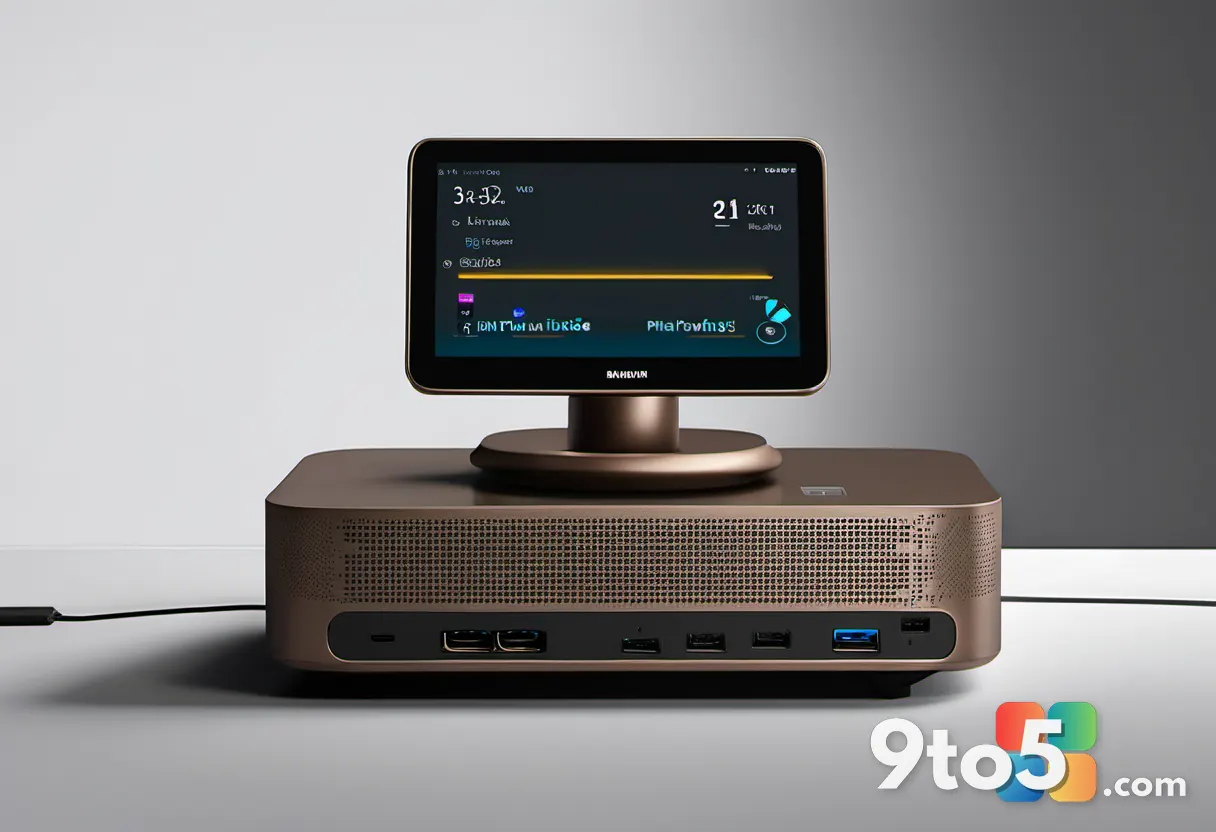
Inside the brushed aluminum chassis, GMKtec deployed a dual-fan vapor chamber cooling system. This is noteworthy because most mini PCs in this size range rely on single-fan passive or active cooling. The second fan, positioned beneath the top cover, features switchable RGB lighting controlled by a dedicated button labeled ‘Fan Mode.’ Despite the name, this button toggles lighting effects rather than fan speeds, a minor design choice that could confuse users expecting direct thermal control.
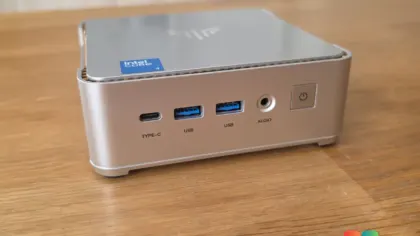
The port layout follows logical conventions. The front panel includes an illuminated power button, one USB 2.0 Type-A port, two USB 3.2 Type-A ports, one USB4 Type-C port, and a 3.5mm headphone jack. These are positioned for convenient access to frequently connected peripherals. The rear panel handles permanent connections, featuring an HDMI output, a DisplayPort, an OCuLink port, two USB 2.0 Type-A ports, dual network interfaces offering 2.5-gigabit and 10-gigabit speeds, and the DC power input.
The OCuLink port deserves particular attention. This external PCIe interface allows connection to an external GPU enclosure with significantly lower latency than USB4-based eGPU solutions. On the EVO-T2S, OCuLink operates at PCIe 4.0 x4, delivering theoretical bandwidth of nearly 8GB/s. This proves valuable when the integrated Arc B390 iGPU reaches its limits or when running GPU-accelerated applications that demand dedicated graphics resources. However, OCuLink does not support hot-swapping, meaning you must power down the system before connecting or disconnecting an eGPU enclosure.
Both USB4 ports support data transfer rates up to 40Gbit/s, DisplayPort Alt Mode, and Power Delivery up to 100 watts. This makes them suitable for high-speed external SSDs, docking stations, or charging compatible laptops. The system supports up to four simultaneous displays via HDMI, DisplayPort, and the two USB4 ports, with manufacturer claims of 8K resolution support. A Kensington lock slot provides security for desktop or office environments.
Build quality appears solid, with uniform panel gaps and a weight that conveys durability without becoming cumbersome. The chassis design prioritizes thermal efficiency while maintaining a professional aesthetic suitable for both home and office use.
Specifications and Hardware Configuration
At the core of the EVO-T2S sits Intel’s Core Ultra X7 358H processor, manufactured on the Intel 18A process. This chip introduces a novel three-tier core architecture: four performance cores (P-cores), eight efficiency cores (E-cores), and four low-power efficiency cores (LP-E-cores). The total count reaches 16 cores and 16 threads, with 18MB of Intel Smart Cache.
Clock speeds vary by core type. The P-cores operate at a base frequency of 1.9GHz with turbo boost up to 4.8GHz. The E-cores reach 3.5GHz, while the LP-E-cores max out at 3.3GHz. GMKtec provides three power profiles: 35 watts in Silent mode, 45 watts in Balanced mode, and 54 watts in Performance mode, with short-term peaks up to 60 watts. Our test unit operated in the Balanced profile, which offers a reasonable compromise between performance and thermals for sustained workloads.
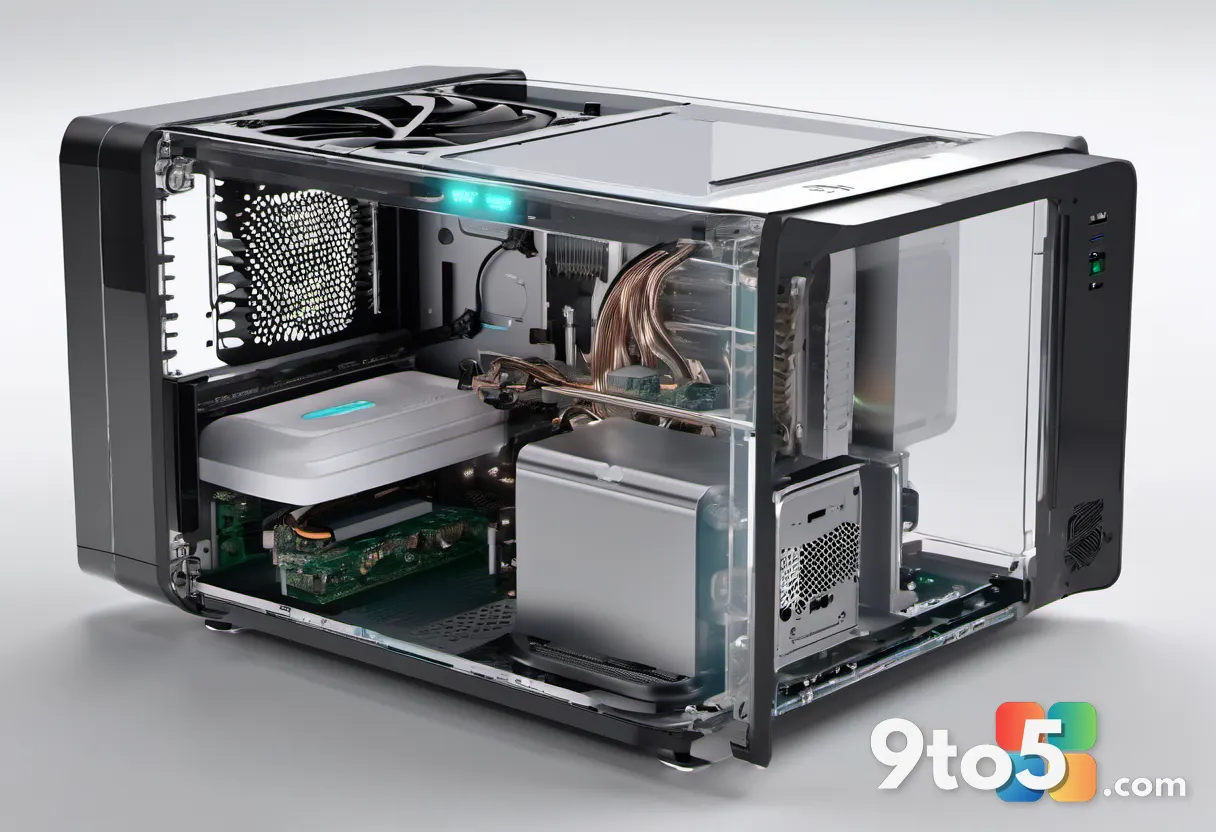
Graphics responsibilities fall to the Intel Arc B390 integrated GPU, featuring 12 Xe3 cores clocked up to 2.5GHz. This represents a substantial generational leap over previous Intel iGPUs, adding support for hardware-accelerated ray tracing and Intel’s XeSS upscaling technology. The Arc B390 shares the system’s memory pool, which is configured with 64GB of soldered LPDDR5X RAM connected via a 256-bit memory interface. This wide bus width benefits both CPU and GPU workloads by reducing memory bottlenecks.
Storage configuration includes a Phison PASCARI A3102K0F853GE101T020H drive, marketed as the Phison aiDAPTIV AI SSD. Total capacity reaches 853GB, divided into a 768GB system partition for Windows and applications, plus a separate 85GB partition dedicated to AI functions. The AI storage area operates on a PCIe 5.0 x4 connection and remains inaccessible as a standard data drive, reserved exclusively for Phison’s AI optimization features.
GMKtec includes proprietary local AI software with the EVO-T2S. The Claw Assistant application processes tasks autonomously and controls multiple AI agents in parallel. An associated model hub provides access to dozens of open-source language models, including Qwen, Gemma, and GPT-OSS, available for local download. This setup appeals to users seeking to run AI workloads without relying on cloud services, though the software shows signs of early development in certain areas.
The integrated Neural Processing Unit delivers up to 50 TOPS of AI performance. Combined with the CPU and GPU, the system achieves a total AI compute capacity of approximately 180 TOPS. This makes the EVO-T2S particularly suitable for local AI model inference, Retrieval-Augmented Generation (RAG) workflows, and running larger language models directly on local hardware.
Connectivity includes Wi-Fi 7, Bluetooth 5.4, and dual network interfaces offering 2.5-gigabit and 10-gigabit Ethernet speeds. The 10-gigabit port proves valuable for connecting to high-speed NAS devices, enabling rapid transfers of large files, backups, media archives, or project folders. This also facilitates direct editing of large photo, video, or AI datasets stored on network storage without local disk constraints.
Windows 11 Pro (Build 10.0.26200) comes pre-installed, with all drivers correctly configured out of the box. The Pro edition provides BitLocker encryption, Hyper-V virtualization, Remote Desktop, and domain connectivity, features typically reserved for business users. The system includes one additional M.2 slot for a second NVMe SSD, though accessing it requires removing four screws hidden beneath adhesive rubber feet on the chassis base. While functional, this design choice adds unnecessary friction for users planning to expand storage.
Performance Testing and Benchmarks
Productivity performance was evaluated using PCMark 10, a standardized benchmark suite that measures real-world computing tasks. The EVO-T2S achieved a total score of 9,864 points, broken down into 11,472 for everyday tasks, 17,317 for productivity workloads, and 13,110 for content creation. These figures place the system well ahead of traditional office mini PCs equipped with Core i5 or Ryzen U processors and align it with compact workstations utilizing HX or H-series processors with higher core counts.
CPU-specific testing employed 3DMark’s CPU Profile suite. The processor scored 8,585 points in the Max Threads test and 8,681 points in the 16-thread test. Single-core performance reached 1,103 points, matching results from high-end laptop processors. This demonstrates that the combination of four performance cores and 12 efficient cores delivers strong results across both multi-threaded and single-threaded workloads.
Graphics performance represents one of the EVO-T2S’s standout features. The Arc B390 iGPU achieved 28,224 points in the Solar Bay ray-tracing benchmark, maintaining over 107 frames per second. This significantly outperforms previous Intel Iris Xe and AMD Radeon 780M integrated solutions found in many office mini PCs. In the more demanding Time Spy benchmark, the system scored 7,600 points, with 3,533 points in the Extreme variant. These results position the integrated graphics on par with older entry-level discrete desktop GPUs.
Ray-tracing-heavy tests like Speed Way and Steel Nomad showed expected frame rate reductions to single-digit or low double-digit figures, a limitation inherent to integrated graphics and the shared memory interface in a compact chassis. For gaming, the EVO-T2S delivers playable performance in Full HD at reduced detail settings with XeSS enabled. 3DMark extrapolated over 70 frames per second in Battlefield V, indicating smooth gameplay for less demanding titles.
Actual gaming performance proved surprisingly capable. Cyberpunk 2077, a graphically intensive title, ran at an average of 48 FPS in Full HD at medium settings. Enabling Intel’s XeSS upscaling in Balanced mode increased the frame rate to 64 FPS, a remarkably smooth result for integrated graphics in a mini PC without a dedicated GPU.

Storage performance was measured using CrystalDiskMark. The 768GB system drive achieved sequential read speeds of 9,167MB/s and write speeds of 8,399MB/s, complemented by strong random access figures. These speeds match current high-end NVMe SSDs, ensuring rapid application loading, game loading, and AI model initialization. The separate 85GB AI storage partition, identified by CrystalDiskInfo as a standalone NVMe 2.0 drive with PCIe 5.0 x4 connectivity, operates independently to optimize AI workloads.
AI performance was evaluated using Geekbench AI’s CPU test. The Core Ultra X7 358H scored 4,186 points in single-precision and 7,943 points in quantized precision. These results place the EVO-T2S ahead of older mini PCs featuring Intel Meteor Lake or AMD Ryzen 8000 processors, confirming the architectural advantages of Panther Lake for AI inference tasks.
Under sustained load, the system maintained stable clock speeds without noticeable thermal throttling. The dual-fan cooling solution effectively managed heat dissipation, even in Performance mode at 54 watts. The included 148-watt power supply provides sufficient headroom for maximum power consumption scenarios.
What This Means for You
The GMKtec EVO-T2S targets a specific audience rather than the general consumer market. At nearly $2,000, the price point places it out of reach for casual users who only need a system for web browsing, document editing, and media consumption. Those users can achieve equivalent performance from significantly less expensive mini PCs.
However, the EVO-T2S delivers genuine value for users with specialized requirements. Local AI enthusiasts will appreciate the 180 TOPS of combined AI compute power and the dedicated AI storage partition, enabling inference of larger language models without cloud dependencies. Creative professionals seeking a compact workstation for rendering, video editing, or 3D modeling will find the 64GB of LPDDR5X RAM and strong multi-core performance beneficial. Gamers willing to accept reduced settings and integrated graphics can enjoy playable Full HD performance without the bulk and power consumption of a desktop gaming rig.
The OCuLink port adds future-proofing for users who may later want to connect an external GPU, though the lack of hot-swap support requires careful planning. The 10-gigabit Ethernet port proves valuable for professionals working with large datasets or media files stored on network storage. Windows 11 Pro pre-installed eliminates the need for an upgrade for users requiring BitLocker, Hyper-V, or domain connectivity.
The pre-installed Claw Assistant software and model hub offer convenience for AI newcomers, though the unpolished state of some features suggests users may prefer third-party alternatives for production workflows. The M.2 expansion slot provides upgrade flexibility, but the access design requires patience during installation.
How to Get It
The GMKtec EVO-T2S with the Intel Core Ultra X7 358H processor and Arc B390 iGPU is currently available at a price point approaching $2,000. GMKtec also offers a higher-tier configuration with the Intel Core Ultra X9 388H processor, marketed as the EVO-T2, though this model is currently out of stock at the time of review.
Prospective buyers should verify current availability and pricing directly with GMKtec or authorized retailers, as stock levels for the X9 configuration fluctuate. The system ships with Windows 11 Pro pre-installed and includes a 148-watt power supply. Given the premium positioning and specialized feature set, this model suits users who prioritize compact form factor combined with desktop-class performance and local AI capabilities.
For users seeking similar performance at lower cost, traditional mini PCs with previous-generation processors remain viable alternatives, though they lack the Panther Lake efficiency gains and Arc B390 graphics capabilities. Conversely, users requiring maximum gaming performance may find dedicated desktop configurations more suitable despite the larger footprint.
Source: PCWorld
Over to you: Would you choose the GMKtec EVO-T2S for local AI workloads, or does the price push you toward a traditional desktop build?