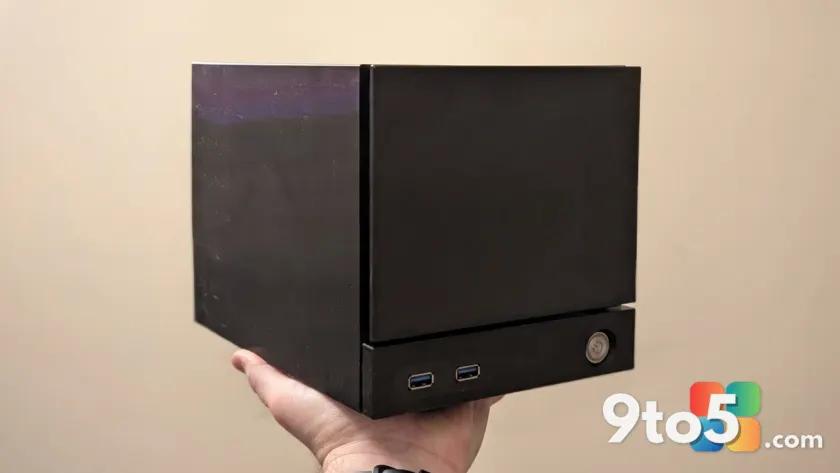
A new entry in the growing list of DIY alternatives to Valve’s upcoming Steam Machine has appeared online. Jacob Terkelsen, an AMD AI GPU engineer, shared photos of his Terk Box v1.1, a compact gaming PC housed in a custom 3D-printed case designed to match the physical footprint of Valve’s console.
The project highlights the enthusiasm surrounding the new Steam Machine while simultaneously demonstrating the significant engineering hurdles involved in replicating its form factor with off-the-shelf components.
Recreating the Steam Machine silhouette
The Terk Box v1.1 is built around a mini-ITX motherboard and powered by a 400W FlexATX power supply unit. The custom chassis measures 167mm x 168mm x 225mm (6.5 x 6.6 x 8.8 inches), placing it very close to the official Steam Machine’s dimensions.
Terkelsen posted the design files on Printables, where a user named 3DCatt created an accompanying parts list. The initial version required modifications; Terkelsen noted that additional ventilation had to be added to the rear of the case to prevent the RTX 5060 graphics card from thermal throttling.
Performance vs. Price reality check
In terms of raw power, the Terk Box offers a substantial upgrade over Valve’s specifications. The Steam Machine utilizes a custom AMD GPU with 8GB of VRAM, which performs roughly on par with an RTX 3060. By contrast, the RTX 5060 in this DIY build represents a significant performance uplift.
However, cost is a major differentiator. Terkelsen clarified that the total expense of building the Terk Box is “nowhere close to $1000,” referring to Valve’s $1,049 price tag for the official Steam Machine. He emphasized that small-form-factor (SFF) builds are notoriously difficult and expensive due to specialized components and cooling requirements.
Why the official Steam Machine might still win
Despite showcasing his impressive DIY project, Terkelsen explicitly recommended Valve’s commercial product. In a follow-up post, he stated that he recommends “the fully-engineered solution Valve has designed, from the software to the mechanical design.”
The Steam Machine arrives as a complete, ready-to-play system with years of refinement behind its hardware and software integration. The Terk Box, while an impressive feat for enthusiasts, requires assembly, troubleshooting, and likely costs more than Valve’s bundled offering when accounting for high-end SFF parts.
What this means for you
The Terk Box v1.1 currently runs on Windows 11 utilizing the Xbox Full Screen Experience (FSE). Terkelsen noted that Linux distributions like Bazzite or CachyOS would also be supported by this hardware configuration.
This DIY project underscores a key limitation of Valve’s current ecosystem: SteamOS officially supports only AMD GPUs. While Valve has stated it is working with NVIDIA to bring support for RTX GPUs, that compatibility is not yet available. Until then, users wanting NVIDIA hardware in a Steam-like console form factor must rely on Windows or Linux alternatives.
Source: Windows Central
Over to you: Would you attempt a DIY build like the Terk Box for better performance, or stick with Valve’s ready-to-play Steam Machine?
You may also like
 Microsoft admits Outlook’s most critical feature is currently broken
 Microsoft to auto-install Microsoft 365 Copilot app on eligible Windows PCs starting June 2026
 Microsoft kills Edge Drop, Collections, and Sidebar to clear the way for Copilot
 Secure Boot deadline passed: What happens to your Windows 11 PC if you missed the update