Intel has become the first driver maker to ship graphics drivers aligned with Microsoft’s Driver Quality Initiative, and the timing coincides with Microsoft openly admitting that a single faulty driver can still take down all of Windows 11.
That’s a lot to unpack, so let’s walk through exactly what Intel shipped, why Microsoft is now publicly pointing the finger at third-party drivers, and what the Driver Quality Initiative actually promises to change for your PC.
Intel is first to ship DQI-aligned GPU drivers
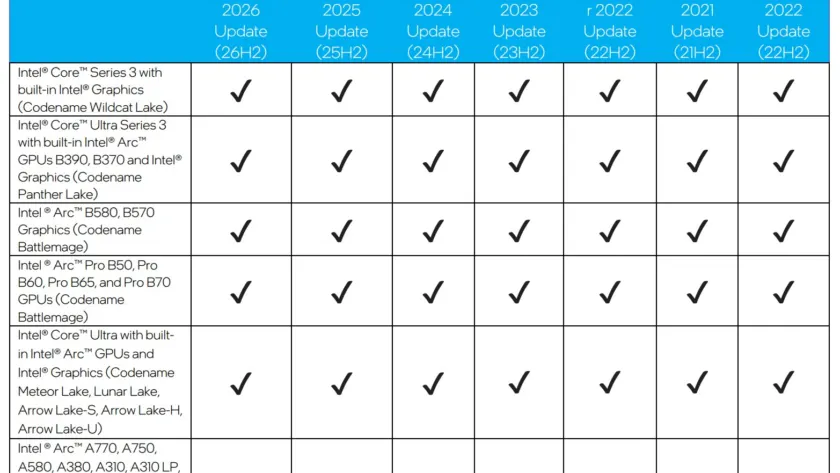
Intel quietly added Windows 11 26H2 support to its GPU drivers with the October 2026 update, version 32.0.101.9034. That may sound like a routine version bump, but it signals something bigger: Intel is the first vendor we’ve seen fold Microsoft’s Driver Quality Initiative (DQI) principles into a public consumer update.
Intel’s Wi-Fi and Bluetooth drivers already began following Microsoft’s new stability guidelines earlier this year, but graphics drivers have historically been the hardest to tame. Arc drivers are now firmly on the list, though Intel hasn’t confirmed whether its legacy integrated graphics drivers will receive the same treatment.
Windows Latest understands that most OEMs are already testing DQI-compliant drivers internally, but those changes aren’t shipping to consumers yet. Intel is the only vendor so far putting this work into public releases.
In our own earlier testing, Intel’s Wi-Fi and Bluetooth drivers were found to follow early DQI practices, though most of the underlying changes still have several months to land. Intel’s Wi-Fi 24.50.0 release notes already referenced “enhancements aligned with Microsoft’s Windows ecosystem quality initiative” aimed at improving performance and user experience.
Why Microsoft is admitting one driver can crash Windows
Here’s the uncomfortable truth Microsoft is now owning: a bad driver is still a Windows problem, even when the fault sits with a third party. When you open Settings for an optional driver update and a crash follows, you blame Windows, not the chipmaker.
The root cause is often architectural. A number of drivers, anti-cheat software included, run in the Windows kernel. When a kernel-mode driver crashes, it takes the entire operating system down with it — the familiar blue screen of death that sometimes names an anti-cheat driver outright.
Microsoft’s documentation puts it plainly: “If a kernel-mode driver crashes, it causes the entire operating system to crash.” That’s why DQI pushes developers toward user-mode drivers or Microsoft-authored class drivers wherever possible, while also hardening the kernel-mode drivers that must stay.
User-mode drivers (UMDF) are safer by design because they only access the address space of their own process. A crash there stays contained instead of nuking the whole system. Microsoft has also invested in user-mode improvements for PCIe devices with DMA support, plus class-driver work covering audio, storage, and new interfaces like the Soundwire Device Class for Audio (SDCA), the I3C class driver, and the NCM USB ethernet class driver.
This architectural reckoning follows real-world pain. Microsoft has acknowledged that Windows Update itself introduced bugs, such as the incident blamed on an Intel Innovation Platform Framework driver that reportedly broke 245 PC models on Dell systems. Even so, Microsoft argues that without a “comprehensive, ecosystem-wide effort designed to fundamentally raise the bar on driver quality, reliability and security,” nothing would actually change.
The Driver Quality Initiative in four pillars
Microsoft first unveiled the Driver Quality Initiative at WinHEC 2026, bringing back the Windows Hardware Engineering Conference after a nearly decade-long hiatus. The previous WinHEC ran in 2018, and Microsoft used the 2026 event to pull its hardware partners back into the driver conversation.
DQI rests on four principles that Microsoft argues should have been standard since day one:
- Architecture
- Trust
- Lifecycle
- Quality Measures
These aren’t features or visual overhauls. Microsoft is explicit that it isn’t asking OEMs to rewrite every Windows 11 driver from scratch, nor is it promising dramatic new looks. It’s about approach, discipline, and shared accountability across the ecosystem.
Microsoft frames it as a partnership: “Microsoft is building the frameworks, tools and quality signals, and we are working with partners to raise driver quality across the ecosystem so customers can rely on their Windows devices from day one through the full life of the PC.”
The framework itself isn’t invented out of thin air. Microsoft says its four pillars are built on lessons learned through the Windows Resiliency Initiative (WRI), the earlier effort that tried to tame crashes and instability. This push also arrives as Microsoft tries to revive Windows after years of being on the back burner, including a major Windows 11 update announced in March 2026.
What each pillar actually changes
On architecture, Microsoft wants to shrink the pool of kernel-mode drivers. The more code that runs in kernel space, the more ways the whole system can collapse, so shifting work to user mode or first-party class drivers is the long-term fix. As Microsoft’s storage driver documentation notes, each system-supplied class driver is “designed to support peripheral devices of a given type and is tested against a number of vendors’ devices.”
Trust is getting stricter. Windows has certified drivers for years, but DQI raises the bar for both the partners and the drivers that pass certification. Expect tighter checks before a driver earns its place in Windows Update.
Lifecycle targets the graveyard of old software. One of DQI’s main goals is to remove outdated and low-quality drivers from the Windows Update catalog so you stop being offered software that was never good to begin with.
Quality measures expand how Microsoft judges a driver. Beyond crashes, it now weighs stability, functionality, performance, and power and thermal impact — meaning a driver that doesn’t crash but quietly drains your battery or pushes up heat can finally be flagged.
What this means for you
For everyday users, the payoff is stability without you having to do anything. The goal is Windows PCs that stay up, run cooler, and hold onto battery across the full life of the machine, rather than degrading after a handful of updates.
It also reframes accountability. Microsoft and partners like Dell agree that when a driver fails, customers experience it as a device problem regardless of where the root cause sits. Dell’s Distinguished Engineer Syam Poluri put it this way: “Great platforms aren’t built in isolation. Platform quality depends on early, honest collaboration across OEMs, ODMs, silicon partners and IHVs.”
The competitive pressure is real too. With Apple’s $599 MacBook Neo helping expand beyond premium laptops and slowly gaining U.S. ground, Microsoft has signaled that Windows quality has to improve or it will keep losing users. As one report framed it, Apple’s gains are effectively forcing Microsoft to build a more efficient Windows 11.
What you should do now
There’s nothing to install today to trigger these changes. DQI is an ecosystem-wide effort that will unfold over months, and Intel’s Wi-Fi and Bluetooth improvements are only the beginning. Keep your drivers current through Windows Update and Intel’s own tools, and watch for more OEMs to ship DQI-aligned updates.
If you’ve been hit by driver-related crashes, the long-term fix is coming — but it’s a marathon, not a sprint.
Source: Windows Latest
Over to you: Do you think forcing third-party drivers into user mode will actually end Windows blue screens, or is this years away from real-world results?