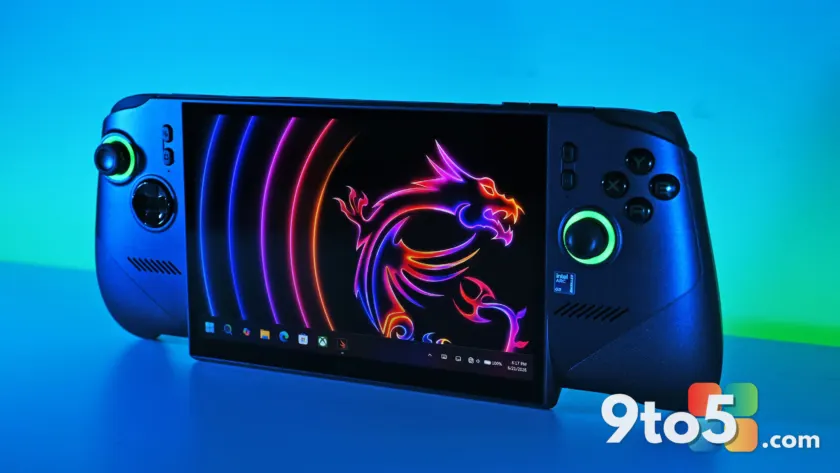
The MSI Claw 8 EX AI+ has arrived, and it is arguably the most powerful Windows gaming handheld available today. Powered by Intel’s purpose-built Arc G3 Extreme processor, this device leaves competitors in the dust regarding raw graphical throughput. However, global supply chain issues have driven the retail price to $1,799, placing it firmly in ultra-premium territory.
MSI has completely redesigned the chassis from its previous prototype-like iteration. The result is a device that feels substantial yet ergonomic, packing an 8-inch display, Hall-Effect controls, and exceptional cooling. Here is how the Claw 8 EX AI+ performs in real-world testing.
#1 Design and Ergonomics
MSI has adopted a form factor that closely mirrors Xbox controllers, featuring flared side grips that contour naturally to your hands. This design choice makes long gaming sessions significantly more comfortable than on bulkier competitors like the Lenovo Legion Go 2.
The device weighs 785 grams, striking a balance between stability and portability. It is light enough to slip into a travel bag without feeling like a brick, yet heavy enough to feel premium. The rear shell is easily removable via six Phillips head screws, granting access to a standard M.2 2280 SSD slot for straightforward storage upgrades.
#2 Display and Controls
The 8-inch IPS touchscreen resolves at 1920 x 1200 (16:10 aspect ratio), offering roughly 38% more screen real estate than typical 7-inch handhelds. It peaks at 500 nits brightness and covers 100% of the sRGB color gamut. Crucially, it supports native Variable Refresh Rate (VRR) from 48Hz to 120Hz, eliminating screen tearing during fluctuating frame rates.
While the lack of an OLED panel means you miss out on infinite contrast in dark rooms, the high refresh rate and responsiveness make for a smooth gaming experience. The controls utilize Hall-Effect analog sticks and triggers, which use magnetic positioning to prevent stick drift entirely. The D-pad features a tactile metal dome for crisp feedback, and the dual 2W speakers provide surprisingly punchy audio.
#3 Performance: Intel Arc G3 Extreme
The Intel Arc G3 Extreme is Intel’s first SoC designed specifically for handheld gaming. It pairs a Xe3-based B390 GPU with 12 Xe-cores and 96 XMX AI Engines, while intentionally reducing CPU core counts to prioritize graphics performance and thermal headroom.
In our lab tests using 3DMark Time Spy, the Claw 8 EX AI+ scored 6,726. This significantly outperforms AMD-powered rivals like the ASUS Xbox Ally X (4,029) and Lenovo Legion Go 2 (3,795). In 3DMark Fire Strike, it achieved an overall score of 13,340, with a graphics score of 16,735.
Real-world gaming reflects these synthetic gains. Titles like 007 First Light ran at over 130 FPS at native resolution on High settings when plugged in. Even graphically demanding games like Cyberpunk 2077 maintained an average of 46.6 FPS at 1920×1200 with Ray Tracing set to Low and XeSS Super Resolution enabled.
#4 Software, Thermals, and Battery Life
The device runs MSI Center M, which integrates libraries from Steam, Xbox, Epic, and Battle.net. It offers three power profiles: AI Engine (automatic optimization), Endurance (capped at 15W for battery saving), and Manual (allowing users to adjust PL1/PL2 power limits up to 35W/45W). The AI Engine is highly effective, requiring little manual intervention.
Thermally, the Cooler Boost HyperFlow architecture keeps the chassis cool. Under load, grip surfaces remained around 96°F (35.7°C), while exhaust vents reached 130°F (54.4°C). The fans produce a low-frequency whoosh rather than a high-pitched whine.
Battery life depends heavily on the power mode. In Endurance Mode with brightness at 45%, the 80Wh battery lasted approximately 3.5 hours during AAA gaming. Lighter indie titles and emulation can push this past the 5-hour mark.
What this means for you
If you have the budget, the MSI Claw 8 EX AI+ is currently the best-performing Windows handheld on the market. Its combination of ergonomic design, drift-proof controls, and raw graphical power sets a new standard. However, at $1,799, it is an enthusiast-only device. For most users, AMD-based alternatives offer better value, even if they sacrifice peak performance.
Source: Windows Central
Over to you: Is the $1,799 price tag justified for the performance boost, or will you wait for prices to drop?