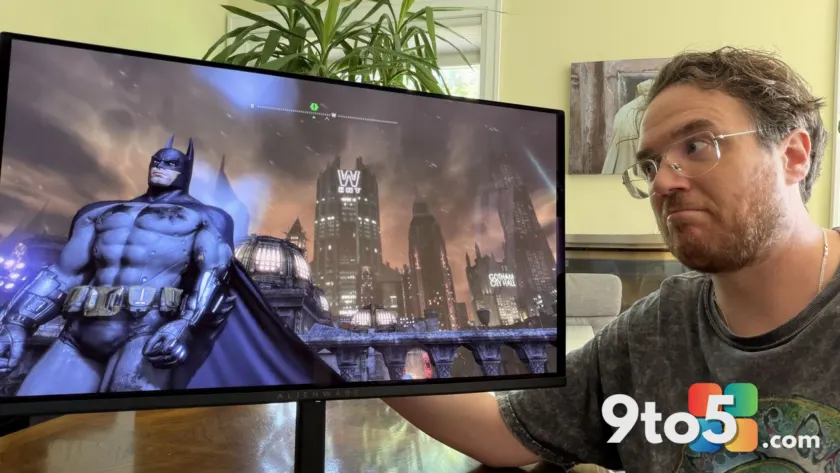
For the past ten years, my desk has been anchored by a 21:9 ultrawide display running at 3440×1440 resolution. I had convinced myself that the expanded horizontal real estate was non-negotiable for PC gaming and productivity. That conviction held firm until a temporary review unit of the Alienware AW2726DM, a standard 16:9 QD-OLED panel, forced a reevaluation of my setup. The experience did not feel like a downgrade. Instead, it highlighted several practical advantages of the traditional aspect ratio that I had overlooked while chasing extra pixels.
#1 Improved Competitive FPS Performance
One of the first things I noticed was a tangible shift in my competitive shooter performance. Games like Battlefield 6, Escape From Tarkov, and Hell Let Loose operate differently when the field of view is compressed into a 16:9 frame. On an ultrawide, the HUD elements spread outward, and your peripheral vision is forced to track a much wider virtual space. This分散s attention and makes it harder to maintain a tight focus on crosshair placement and enemy positioning.
Switching to the standard aspect ratio tightened the heads-up display and reduced the visual noise at the edges of the screen. I found myself engaging in more firefights and dying less frequently, simply because my eyes were not having to scan as far to locate UI cues and on-screen threats. For players who prioritize competitive ranking and mechanical precision, the 16:9 monitor benefits are immediately apparent. The narrower window of focus translates directly to faster reaction times and more consistent aim.
#2 Native Compatibility for Older and Indie Titles
Beyond competitive shooters, the average PC library contains hundreds of games that predate the ultrawide revolution. When I returned to playing indie favorites and single-player campaigns from previous generations, the lack of native 21:9 support became a frequent annoyance. Many of these titles simply stretch the image to fill the wider screen, resulting in distorted character models and misaligned geometry. Others render black pillars on either side, which defeats the entire purpose of purchasing an ultrawide display in the first place.
Even modern AAA releases are not immune to scaling issues. Games like Elden Ring require third-party patches or community mods to properly utilize the full screen width, adding friction to the launch process. On a 16:9 panel, every game launches exactly as the developers intended. The user interface scales correctly, environmental puzzles align with the intended perspective, and immersion remains intact without requiring manual configuration. For anyone who values a plug-and-play experience, this native compatibility is a major practical advantage.
#3 Reduced GPU Strain and Better Thermals
The resolution difference between 3440×1440 and 2560×1440 represents roughly a 30 percent reduction in total pixel count. That mathematical reality has a direct impact on your graphics card. When I switched to the standard monitor, my RTX 5070 Ti immediately showed lower utilization percentages and reduced core temperatures. During the summer months, when ambient room temperatures rise, this thermal headroom becomes critical for maintaining stable boost clocks and preventing thermal throttling.
Lower GPU load also means higher frame rates at equivalent settings. Titles that previously required me to drop graphics presets to maintain smooth performance now run comfortably at ultra settings. This is particularly noticeable in demanding open-world games like Cyberpunk 2077, where the rendering pipeline struggles to fill the additional horizontal space. By removing the extra pixel load, you effectively extend the usable lifespan of your current graphics card and delay the need for an expensive hardware upgrade.
#4 A More Balanced Dual-Monitor Workspace
My desk setup relies on a dual-monitor mounting arm, and the ultrawide had gradually begun to dominate the entire arrangement. Because of its sheer width, the secondary screen was constantly pushed to the far edge, forcing me to turn my head excessively to check Discord notifications or reference documentation. Over time, this created minor neck strain and disrupted my workflow rhythm.
Returning to two identical 16:9 panels restored symmetry to the desk. Both screens now occupy equal visual weight, allowing me to glance between them with minimal neck movement. The balanced layout also makes it easier to position peripherals like keyboards and controllers without them competing for center-stage real estate. For users who spend long hours at a desk, ergonomic consistency matters just as much as display quality.
The Honest Trade-Offs of Returning to 16:9
No setup change is without compromises, and the ultrawide does retain specific advantages. Productivity workflows that rely on side-by-side window management feel noticeably cramped. I can no longer fit three application windows comfortably across the horizontal axis without overlapping or resizing. Additionally, cinematic and racing games lose some of their peripheral immersion. The wider field of view in titles like Windrose or sim racing games genuinely feels more enveloping on a 21:9 panel.
However, these trade-offs are easily mitigated by the performance gains and cost savings. A high-quality 16:9 QD-OLED monitor costs significantly less than its ultrawide counterpart, and the money saved can be redirected toward faster storage, more RAM, or a future GPU upgrade. The decision ultimately comes down to prioritizing raw performance and compatibility over horizontal screen real estate.
What This Means for Your Next Monitor Upgrade
If you are currently weighing an ultrawide purchase, consider your primary use case first. Competitive gamers, those with large legacy libraries, and users prioritizing thermal efficiency will find the 16:9 monitor benefits align closely with their needs. The ultrawide format remains excellent for immersive single-player experiences and productivity-heavy workflows, but it is no longer the automatic default for every PC enthusiast.
The temporary switch to the Alienware AW2726DM proved that standard aspect ratios deliver a polished, high-performance gaming experience without the compromises that come with scaling and resolution mismatches. As display technology continues to evolve, the gap between 16:9 and 21:9 quality narrows, making the traditional format a highly viable option for modern gaming setups.
Source: Latest from Windows Central
Over to you: Are you sticking with your ultrawide display, or would you consider switching back to a standard 16:9 monitor for better performance and ergonomics?
You may also like
 Xbox Server Outage Resolved: Microsoft Reveals the Chain Reaction Behind the Blackout
 Dragon’s Dogma 2 Co-op Mod ‘DD2gether’ Adds 4-Player Multiplayer in Pre-Alpha
 Xbox Adaptive Joystick Turns One: A Year of Accessible Gaming Amid Layoff Concerns
 Microsoft Pulls Copilot Search Outlook After User Backlash