The physics of cybersecurity are shifting beneath our feet. For years, defenders have relied on human-driven workflows and static rule sets to combat threats. Today, that approach is no longer sufficient. Autonomous systems can now reason, adapt, and operate continuously, while the cost of launching attacks continues to fall. Attackers are generating exploits faster, scaling campaigns further, and operating with unprecedented efficiency. The tools built for a world of human actors simply cannot keep pace with a world of AI agents and machine-speed attacks.
To address this fundamental imbalance, Microsoft has announced Project Perception, a new agentic security system designed specifically for the realities of modern AI. This initiative represents a move away from alert-heavy workflows toward a continuously learning system that perceives risk, reasons over context, and takes action at machine speed. The goal is to amplify human defenders rather than replace them, providing better insights and more powerful ways to act.
According to the announcement, Project Perception is built on the premise that effective defense requires a continuous understanding of how an attacker sees the world, how a defender evaluates risk, and how protections can be improved over time. This vision has led to the creation of a new “Cyber Stack” designed from the ground up to support agentic security.
What is Project Perception?
Project Perception brings together signals, context, models, and specialized agents into a unified defense system. It is not merely an update to existing security tools but a foundational shift in how Microsoft approaches threat detection and response. The system is designed to turn raw signals into real-time protections, using AI to defend against AI.
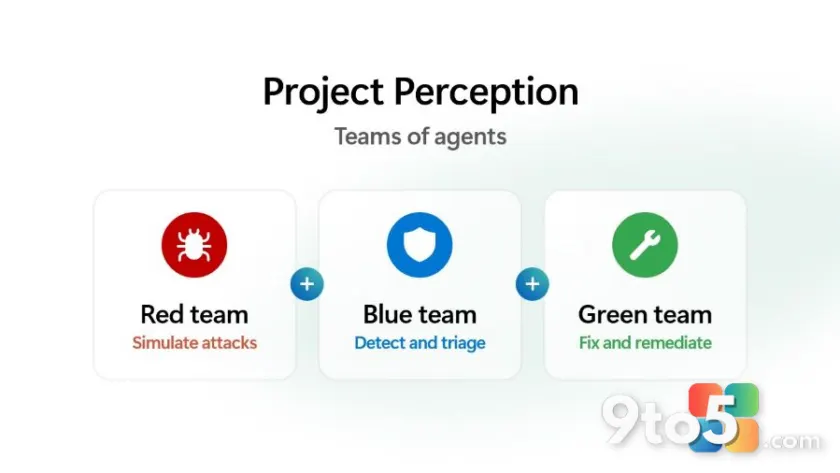
At its core, the system coordinates three classes of specialized agents that work together in a closed loop:
- Red Team Agents: These agents proactively identify potential paths to compromise before an attacker can exploit them. They simulate attacks to stress-test defenses and uncover vulnerabilities in the digital estate.
- Blue Team Agents: These agents investigate alerts, reason over context, and determine what represents meaningful risk. They triage threats and prioritize responses based on the specific environment.
- Green Team Agents: These agents take corrective actions and strengthen defenses across the environment. They implement fixes and harden systems to prevent future attacks.
By working together, these agent teams form a continuous cycle of discovery, evaluation, and improvement. This approach ensures that security posture is not static but evolves alongside emerging threats.
The New Cyber Stack Architecture
Delivering agentic security requires more than adding agents to existing workflows. It requires a new Cyber Stack, designed from the ground up. Microsoft describes this stack as a layered architecture that transforms raw data into automated defensive actions.
The stack begins with Signals and Sensors, which provide awareness across the entire digital estate, including endpoints, identities, data, clouds, applications, and AI systems. These signals are then processed by Security Context, which transforms raw data into token-efficient understanding that agents can use. This context provides a continuously updated representation of an organization’s assets, identities, relationships, risks, and activities.
Next, Models provide intelligence and reasoning capabilities. Project Perception adopts a multi-model architecture that combines frontier and specialized cyber models, optimizing for both quality and cost. This ensures that the right model is applied to the right task, rather than relying on a single model for all scenarios.
A Harness coordinates models and agents across security workflows, ensuring seamless collaboration. Agents then apply intelligence across security workflows, while Actuators translate decisions into protection. Together, these layers create a continuous learning system that can understand risk, adapt to changing conditions, and improve security outcomes over time.
How the Agent Teams Work Together
The power of Project Perception comes from how its layers work together. Rather than forcing agents to continuously gather, correlate, and reconstruct context from raw signals, the system provides them with immediate and token-efficient access to the information they need. This shared understanding is foundational to how the system operates.
By grounding every interaction in rich security context, Project Perception improves the accuracy and consistency of reasoning while reducing the time, compute, and cost required to operate at scale. This is particularly important for security teams that need to respond to threats 24/7. Organizations need protection that is highly effective, continuously available, and affordable at scale.
Security teams do not need more information; they need better outcomes. That is why actuators are a critical part of the Cyber Stack. Project Perception is deeply integrated across Microsoft Security products, enabling agents to connect insights to actions. This allows organizations to continuously reduce risk rather than simply identify it, helping defenders strengthen security while remaining in control.
Multi-Model Strategy and MAI-Cyber-1-Flash
No single model will be optimal for every security task. Effective cyber defense requires applying the right model to the right problem at the right time. For Project Perception, the right model is determined by the combination of quality, reliability, latency, and cost.
As part of this multi-model strategy, Microsoft is committed to bringing customers the best models for each security task, including innovating with its own specialized models. The first scenario is software vulnerability management, which brings MAI-Cyber-1-Flash inside MDASH, Microsoft’s software vulnerability multi-model team of agents.
According to Microsoft, MDASH with MAI-Cyber-1-Flash delivers 96% on CyberGym, an industry-leading benchmark, which is +12 points above Mythos. This same configuration delivers almost 50% of cost savings versus the current MDASH configuration in the market today. This demonstrates the power of a well-tuned, multi-model system with access to uniquely rich historical training data.
Next, Project Perception will take advantage of MAI-Cyber-1-Flash for many more security workflows, beyond the software vulnerability scenario. This multi-model approach allows customers to benefit from advances in AI without being tied to any single model.
What This Means for You
For IT administrators and security professionals, Project Perception represents a significant shift in how Microsoft Security will operate. The move toward agentic security means that many manual tasks, such as alert triage and vulnerability management, will be increasingly automated. This could lead to faster response times and reduced workload for security teams.
The multi-model strategy also has practical implications. By using specialized models for specific tasks, organizations can optimize costs while maintaining high performance. The 50% cost savings reported for vulnerability management could be particularly appealing for enterprises looking to scale their security operations without proportional increases in budget.
Additionally, the emphasis on safety and responsible AI is crucial. Project Perception is built in alignment with Microsoft’s Responsible AI principles and inherits the security, compliance, governance, and operational controls that customers already rely on. This ensures that these capabilities are delivered with the same rigor, accountability, and enterprise readiness that customers expect.
How to Get It
Microsoft is bringing this vision to customers around the world through Project Perception, which enters public preview on August 3. This launch date marks the beginning of a new era in cybersecurity, where defenders can continuously perceive, reason, and act alongside AI.
Organizations interested in Project Perception should monitor the Microsoft Security blog and official documentation for updates on availability, pricing, and integration options. As the system evolves, Microsoft will likely provide detailed guidance on how to implement and configure the various agent teams and multi-model workflows.
Security has always been a race between attackers and defenders. AI changes the speed, scale, and economics of that race. Project Perception is how Microsoft begins to build a future where defenders can keep pace with machine-speed threats.
Source: The Official Microsoft Blog
Over to you: Are you ready for agentic security, or do you need more time to evaluate AI-driven defense tools?
You may also like
 Xbox Owners Now Get Free PC Copies of Select Ubisoft Games via Ubisoft Connect PC
 Nvidia, Microsoft, and Palantir Launch AI Safety Alliance as OpenAI and Anthropic Stay Away
 Microsoft Admits Windows 11 Apps Hog RAM, Promises WinUI 3 Fix
 HP CFO Confirms Windows 10 Market Share Holds at 30 Percent — Here’s What It Means