Five years ago, Microsoft introduced a product that fundamentally redefined how enterprises think about endpoint computing. Today, as we mark the Windows 365 anniversary, the platform has grown from a novel experiment into a cornerstone of modern IT infrastructure. Tens of thousands of organizations across industries and around the world are now running their daily operations on Windows 365 Cloud PCs, relying on a familiar Windows desktop that executes securely within the Microsoft Cloud.
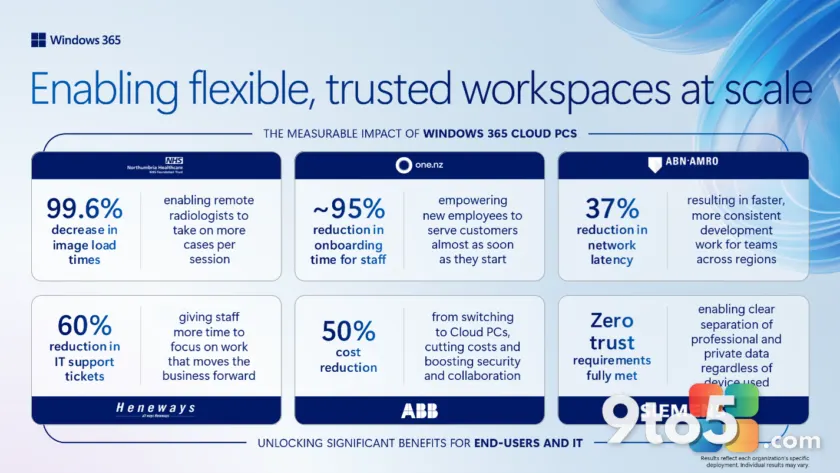
Customer feedback collected over this five-year period tells a consistent story. Organizations are reporting measurable reductions in infrastructure costs, lower network latency for distributed teams, fewer helpdesk support tickets, and significantly faster employee onboarding times. The shift away from traditional physical endpoints has not only streamlined IT operations but also created a more resilient foundation for hybrid and remote work models that show no signs of slowing down.
Reflecting on this milestone, Microsoft is highlighting the key advancements that have earned the platform widespread industry recognition, sharing insights on where enterprise leaders should focus their strategies next, and detailing the new capabilities that are pushing Cloud PCs into uncharted territory. While the increasing adoption of AI and autonomous agents is changing how work happens, the core requirement for secure, managed, and reliable workspaces remains unchanged.
Industry Validation: Gartner and IDC Recognition
As part of the Windows 365 anniversary celebrations, Microsoft announced that it has been named a Leader for four consecutive years in the 2026 Gartner® Magic Quadrant™ for Desktop as a Service. The report positions Microsoft highest in the Ability to Execute category, a distinction that reflects the platform’s comprehensive integration of endpoint management, identity, security, and compliance as native prebuilt components.
Gartner defines desktop as a service (DaaS) as the provision of virtual desktops by public cloud or other service providers. The 2026 evaluation underscores how Microsoft’s strategy has evolved from simply virtualizing Windows to delivering a fully integrated stack that addresses modern enterprise complexity. According to the report, Microsoft stands out as the only vendor to productize the agentic workspace as a distinct purchasable offering alongside the standard managed desktop, providing a robust production foundation for IT leaders whose DaaS strategies must accommodate AI agent deployment over the next three years.
Parallel to the Gartner recognition, Microsoft was also named a Leader in the IDC MarketScape: Worldwide Desktop as a Service 2026 Vendor Assessment. The IDC evaluation measures vendor product, go-to-market, and business execution in the short-term, while also assessing the alignment of vendor strategies with customer requirements over a three-to-five-year timeframe. Microsoft’s position furthest along both the capabilities and strategies axes highlights the platform’s dual focus on immediate operational excellence and long-term architectural readiness.
These dual recognitions are not merely ceremonial. For IT administrators and CIOs evaluating virtual desktop infrastructure, they provide independent validation that Cloud PCs have matured beyond the pilot phase. The emphasis on security, compliance, and AI readiness in both reports signals that the market is no longer asking whether to move to the cloud, but rather how quickly and securely they can do it. Microsoft’s consistent positioning at the top of these evaluations reflects a deliberate strategy to embed enterprise-grade governance into the core architecture rather than bolting it on as an afterthought.
Expanding the Windows 365 Portfolio
Over the past five years, the Windows 365 ecosystem has diversified to meet the specific needs of different workforce segments. What began as a standard Cloud PC offering has expanded into a modular suite designed to handle everything from shift-based frontline work to specialized development environments.
Windows 365 Flex was introduced to provide Cloud PCs for part-time, shift-based, or occasional use. This is particularly valuable for retail, healthcare, and manufacturing environments where employees rotate through different stations and do not require a dedicated physical machine. Windows 365 Reserve addresses business continuity by equipping employees with temporary Cloud PCs if their physical devices are unavailable due to theft, loss, or hardware failure. Windows 365 Link serves as the simple, secure purpose-built device for Windows 365, especially useful for shared workspaces where hygiene and rapid turnover are priorities.

The most strategically significant addition, however, is Windows 365 for Agents. This offering provides a secure execution environment for AI agents to run, marking a fundamental shift in how Microsoft views the role of the Cloud PC. Rather than being solely a workspace for human users, the Cloud PC is now positioned as a compute resource for autonomous software workflows. These solutions are making it easier for more customers to adopt cloud-powered Windows experiences in ways that fit their workplace needs, while the continued commitment to providing secure, managed, and reliable workspaces for both human and agentic workforces at scale has earned the industry recognition detailed above.
New Tools for Developers
During Microsoft Build 2026, several announcements were made specifically targeting the developer community, addressing long-standing requests for more powerful and flexible Cloud PC configurations. The most notable preview release is the introduction of ready-to-code Cloud PCs preconfigured with common development tools. These images eliminate the traditional friction of setting up development environments from scratch, allowing engineers to spin up a fully functional workspace in minutes.
For teams working on graphics-intensive or compute-intensive workloads like software development, data modeling, simulations, and AI/ML, Microsoft announced the general availability of a new Windows 365 GPU Select offering alongside 32vCPU Windows 365 Cloud PCs. These configurations provide the raw horsepower necessary for compiling large codebases, running local models, and executing complex data pipelines without the latency and cost associated with on-premises GPU clusters.

A particularly impactful development for AI-focused teams is the ability to run select language models directly on Cloud PCs. This enables developers building AI-powered apps to use Cloud PC compute to build and iterate effectively without incurring token costs. By leveraging local inference, teams can test prompts, evaluate outputs, and debug model behavior in a fully isolated environment that mirrors production conditions. Additionally, always-available Cloud PCs enable long-running builds, test loops, dev environments, and AI-assisted workflows to be persistent beyond the limits of a physical device, so work can continue on a Cloud PC even when a physical device goes to sleep. This persistence is a game-changer for global development teams working across time zones.
Windows 365 for Agents Goes Mainstream
Earlier this year, Windows 365 for Agents reached general availability, moving from concept to production-ready infrastructure. The platform provides a collection of Microsoft Entra-joined, Microsoft Intune-managed, and policy-enforced Cloud PCs for agents to execute multi-step workflows across software. This includes opening apps, navigating interfaces, entering inputs, and processing data, all within a governed environment that maintains audit trails and security boundaries.
Companies such as Login VSI, Simular, and WorkspaceDNA are already building AI agents that can run on Windows 365 for Agents, demonstrating the platform’s immediate utility for enterprise automation. At Microsoft, the technology is being used to power agentic experiences such as computer-use scenarios in Researcher, proving that the architecture can handle complex, multi-application tasks reliably.

Looking ahead, Microsoft is introducing new capabilities to enable secure use of enterprise-grade AI agents. Now in preview, Windows 365 for Agents supports accessing on-premises applications using agents’ identities, enabling organizations to extend automation across legacy business applications without modernizing existing applications. Also in preview, support for linking Windows 365 for Agents Cloud PC agent pools to either a Microsoft Entra group or a Microsoft Intune Autopilot device preparation profile is being introduced. This enables IT administrators to manage Cloud PCs for agents at scale by applying security and compliance policies, deploying required applications, maintaining consistent configurations across agent pools, and using existing Intune workflows.
Additionally, with Windows 365 support for Microsoft Execution Containers (MXC) becoming generally available in the coming months, customers can securely run supported agent workloads, from coding agents like GitHub Copilot CLI to autonomous agents like OpenClaw, on managed, always-available Cloud PCs using process and session isolation with familiar enterprise security and governance controls. This containerization approach ensures that agent workloads do not interfere with each other or with host system resources, a critical requirement for multi-tenant enterprise deployments.
Strengthening Security and Management
Security remains a foundational pillar of the Windows 365 architecture. Cloud PCs enable organizations to reduce their attack surface by having data remain secure in the Microsoft Cloud rather than on dispersed endpoints. Earlier this year, Microsoft introduced context-based redirections using Microsoft Entra authentication context, enabling more precise control over how users access Cloud PCs. This allows administrators to dynamically adjust security policies based on the user’s location, device health, and network environment.
Further strengthening defenses against endpoint threats, output protection capabilities are becoming generally available in September. This feature ensures that displayed content on a Cloud PC stays shielded from screen scrapers and other endpoint threats, which is particularly important for regulated industries handling sensitive financial, healthcare, or legal data.
On the management side, the new Windows 365 monitoring and reporting platform becomes generally available in September, alongside a new agent for Windows 365 administrators now available in limited preview. IT admins can more easily monitor Cloud PC health in Microsoft Intune, investigate issues, identify likely root causes, and accelerate troubleshooting through a guided conversational experience that streamlines analyzing operational signals and insights across the Cloud PC environment. This AI-assisted management layer significantly reduces the cognitive load on IT teams responsible for maintaining large-scale virtual desktop fleets.
What This Means for You
For IT leaders and developers, the Windows 365 anniversary marks a clear inflection point. The platform is no longer just a replacement for physical PCs; it is becoming a compute fabric that supports human workers, automated workflows, and AI agents simultaneously. If you are currently evaluating DaaS options, the consistent top-tier positioning in Gartner and IDC reports provides strong independent validation. For developers, the new GPU and 32vCPU options, combined with local LLM support, make Cloud PCs a viable primary development environment for the first time. Organizations should assess whether their current endpoint strategies can keep pace with the demand for secure, flexible, and AI-ready workspaces.
How to Get It
Organizations looking to discuss Windows 365 use cases across information work, frontline work, software development, and AI agents can contact Microsoft sales to assess Cloud PC plans. For those seeking a secure execution environment for emerging agents, Microsoft offers 50 free hours of Windows 365 for Agents Cloud PC with Microsoft Copilot Studio. Businesses dealing with device loss or hardware refreshes should consider Windows 365 Reserve for business continuity or Windows 365 Link as a cost-effective alternative to traditional desktops. Complete details on the admin agent preview and monitoring platform are available through the official Windows 365 documentation and partner portals.
Source: Windows Blog
Over to you: Which Windows 365 offering do you think will see the most adoption in the coming year?