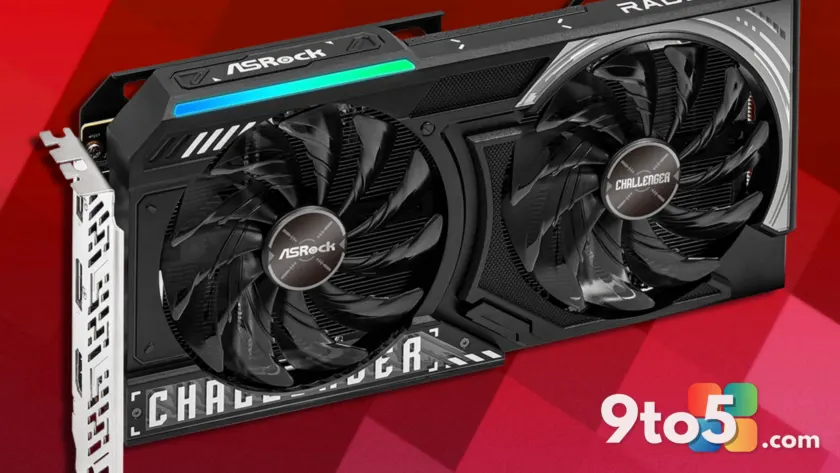
After months of speculation and a day of leaks, AMD has officially pulled back the curtain on the Radeon RX 9050. Positioned as the entry point for the new RDNA 4 generation, this Navi 44-based GPU shares its silicon with the recently launched RX 9060 and RX 9060 XT. However, the announcement has quickly drawn attention for a different reason: the return of 4GB of VRAM on a desktop graphics card, a specification that has been largely absent from the market for several years.
The Radeon RX 9050 Officially Announced
AMD’s official product page currently lists the RX 9050 with a maximum memory size of 8GB. Yet, a closer look at partner specifications reveals a more nuanced picture. ASRock’s listing for its Challenger variant of the card clearly displays two distinct configurations: one with 8GB of GDDR6 memory and another with just 4GB. This discrepancy initially left enthusiasts wondering which version would actually reach the market.
According to an AMD representative, the 4GB model is strictly a “system-only variant.” It is designed exclusively for pre-built desktop PCs and will not be available as a standalone retail product. To achieve this lower memory footprint, the 4GB variant also features a 64-bit memory bus, exactly half the width of the 128-bit bus found on the 8GB model. This reduction cuts overall memory bandwidth in half, a significant compromise for a gaming GPU.
In terms of raw specifications, the RX 9050 packs 16 compute units, 16 ray tracing cores, 64 texture units, and 1,024 stream processors. These figures place the card at roughly one-quarter the performance tier of AMD’s current flagship RDNA 4 silicon. It represents the company’s first new desktop GPU release in nearly a year, filling a gap left by the previous RDNA 3 generation.
The 4GB Variant: OEM-Only and a Step Backward?
The reintroduction of 4GB of VRAM feels like a deliberate step backward for modern PC gaming standards. The last time AMD shipped a 4GB desktop GPU, it was the RDNA 2-based Radeon RX 6400 in 2022. That same year, Nvidia launched the GTX 1630 and Intel debuted the Arc 3 A370M, both of which also relied on 4GB of memory. Since then, 8GB has firmly established itself as the absolute minimum baseline for new gaming hardware, a threshold that many enthusiasts argued was already insufficient for modern titles even back in 2025.
While the 4GB RX 9050 will not disrupt the retail market directly, its presence in pre-built systems sets a concerning precedent. Budget gaming PCs often push the boundaries of acceptable performance to hit aggressive price points. By offering a GPU with halved memory bandwidth, AMD is effectively enabling system builders to market machines that may struggle with current generation games at even medium settings. It echoes the broader industry trend of shrinking VRAM capacities to combat rising component costs, a move that prioritizes short-term affordability over long-term usability.
What This Means for You
If you are shopping for a standalone graphics card, the 4GB RX 9050 will not impact your decision-making process. You will not find it on store shelves or in online retailer listings. The 8GB variant, however, offers a legitimate entry point into the RDNA 4 ecosystem. For roughly $279, it delivers a modern architecture with support for upscaling technologies and decent 1080p gaming performance, sitting well below the $400 price tag of the RX 9060 XT.
However, if you are considering purchasing a pre-built gaming desktop, you need to scrutinize the specifications carefully. A system listing an RX 9050 might contain the 4GB OEM variant, which will perform noticeably worse than its 8GB counterpart. Always verify whether the included GPU has a 64-bit or 128-bit memory configuration, as this single detail dictates the card’s actual gaming potential. AMD’s clarification ensures that the 4GB model remains confined to system integrators, but it does not change the fact that 4GB is no longer a viable standard for new hardware.
How to Get It
AMD has confirmed that the RX 9050 8GB will launch with an introductory price of $279 USD. However, availability is initially restricted to specific regions. The card will first arrive in Latin American and APJ (Asia-Pacific and Japan) markets. AMD has not yet provided a timeline for a global rollout or confirmed release dates for North American and European stores. Enthusiasts waiting for the retail version will need to monitor official AMD announcements for updates on international distribution.
Source: PCWorld
Over to you: Are you willing to buy a pre-built PC with 4GB of VRAM, or will you wait for the 8GB retail version?