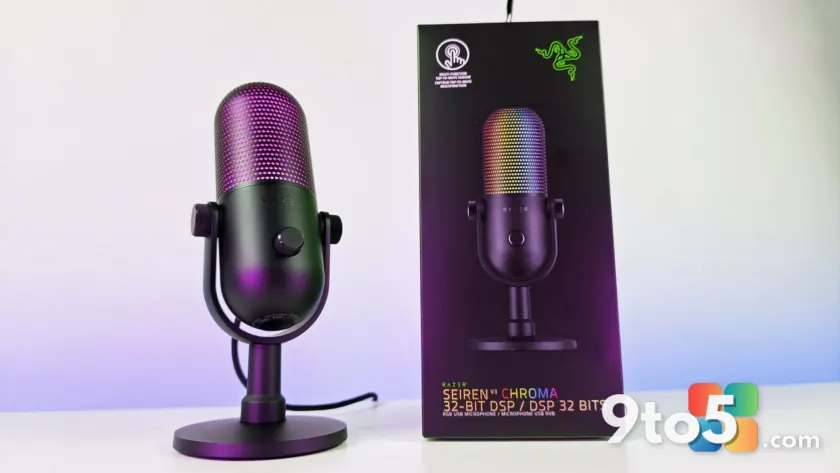
The Razer Seiren V3 Chroma has arrived as the direct successor to the original Chroma model, and the shift in internal architecture is immediately noticeable. Razer has replaced the previous digital signal processing chain with a 32-bit float system, a change that fundamentally alters how the microphone handles dynamic range and transient peaks. This is the same processing approach used in the recently reviewed Seiren V3 Pro, which retails for $249.99, but Razer has managed to integrate it into a more affordable and visually distinct package. For creators who have previously avoided USB microphones due to dynamic range limitations, this update addresses a core technical bottleneck.
Priced at $119.99 directly through Razer.com, or $199.99 at Best Buy, the Seiren V3 Chroma occupies a strategic middle ground in Razer’s audio lineup. It sits well below the V3 Pro while retaining a significant portion of the advanced processing features that typically require a higher investment. The move to 32-bit processing means the microphone can capture quieter sounds with greater detail while preventing distortion during loud outbursts, a common issue with 16-bit or 24-bit USB condensers. This review breaks down how the new DSP architecture performs in real-world streaming and recording scenarios, alongside the software ecosystem that powers it.
Design and Build Quality
The physical form factor of the Seiren V3 Chroma remains consistent with the cylindrical chassis that defined the previous generation. Razer has retained the perforated metal grille and the prominent RGB ring that wraps around the upper housing. The lighting output is notably bright and uniform, capable of displaying everything from a single static hue to complex, multi-zone Chroma effects. The build quality feels substantial, with a weighted base that resists tipping during vigorous use. The tap-to-mute sensor located on the top surface responds with tactile precision, and the USB-C connection port provides a modern, reversible cable path that eliminates the frustration of older USB-A connectors.
One practical improvement is the availability of multiple colorways. Beyond the standard black finish, Razer offers Quartz and White variants, which allows users to coordinate the microphone with lighter desk setups or peripheral themes. The materials used in the grille and housing resist fingerprints better than the glossy finishes found on earlier models, which is a welcome change for users who frequently adjust their equipment. The microphone’s supercardioid condenser capsule focuses on on-axis sound while rejecting off-axis noise, a directional pattern that remains effective for users who sit directly in front of their monitors.
Setup and Synapse Integration
Connecting the Seiren V3 Chroma requires no external drivers. The device is recognized immediately as a standard USB audio input, but the full feature set unlocks only through Razer Synapse. The standout addition in this generation is the Synapse tuning wizard, a calibration tool that streamlines the initial setup process. The wizard runs for approximately thirty seconds and prompts the user to answer a few questions about their acoustic environment and speaking distance. Based on those inputs, the software automatically adjusts gain staging, noise reduction thresholds, equalization curves, and compression ratios. This automated approach is particularly useful for users who switch between different recording spaces or who lack experience with manual audio calibration.
The equalization tools within Synapse provide granular control for those who prefer manual tuning. Users can select from preset vocal profiles or access a full parametric equalizer with multiple frequency bands, high-pass filters, and vocal enhancement filters. The interface renders frequency curves in real time, and the live audio preview allows for immediate A/B testing of adjustments. For IT administrators or power users managing multiple workstations, the ability to save and export profiles ensures consistent audio settings across different recording environments. The software also handles the AI noise suppression and automatic EQ features, which operate entirely on the microphone’s onboard processor, reducing CPU load on the host system.
Audio Quality and DSP Performance
The transition to 32-bit digital signal processing delivers a measurable improvement in dynamic range. In practical terms, this means the microphone can handle sudden volume spikes without clipping, while still capturing the subtle nuances of quiet speech. The onboard DSP manages compression, limiting, and noise reduction independently of the host computer, which keeps the audio signal clean even in acoustically untreated rooms. When compared to the original Seiren V3 Chroma, the difference is pronounced. The older model could sound thin or harsh when gain was increased, whereas the 32-bit DSP version maintains a stable noise floor and consistent tonal balance.
When positioned against the Seiren V3 Pro, the Chroma version closes the performance gap significantly. The Pro retains an advantage due to its larger dynamic capsule and XLR connectivity, which provides additional depth and routing flexibility for studio environments. However, for daily streaming, podcasting, and voice communication, the Chroma 32-Bit DSP delivers broadcast-ready clarity without requiring external audio interfaces. The supercardioid pickup pattern effectively isolates the user’s voice, and the AI noise suppression successfully filters out mechanical keyboard switches, desk fans, and ambient room reflections. Users who prioritize a straightforward plug-and-play workflow will find the audio output sufficiently polished for professional use.
RGB Customization and Features
The RGB lighting system on the Seiren V3 Chroma is deeply integrated with the Razer Chroma ecosystem. The lighting ring can be configured to react to in-game events, chat notifications, or real-time audio levels, adding a dynamic visual element to the streaming setup. Users can also map double-tap and triple-tap gestures on the top sensor to trigger specific lighting changes or toggle audio settings, which reduces the need to alt-tab into software during live sessions. The lighting customization extends to individual zones within the ring, allowing for complex patterns and color gradients that can be synchronized with other Chroma-enabled peripherals.
While the visual customization is extensive, the core functionality of the microphone remains independent of the lighting features. Users who prefer a minimalist aesthetic can disable the RGB entirely through Synapse, leaving the microphone in a purely functional state. The tap-to-mute sensor provides immediate visual feedback by shifting the ring color to red when muted, which serves as a clear indicator for both the user and their audience. The combination of hardware-level controls and software-level customization ensures that the microphone can adapt to different workflow preferences without compromising on audio performance.
Price and Value Comparison
At $119.99, the Seiren V3 Chroma is positioned to compete directly with established USB microphones in the mid-range segment, including the HyperX QuadCast S and the Elgato Wave:3. The pricing strategy makes the 32-bit DSP architecture accessible to users who previously considered it a premium feature reserved for higher-tier models. The inclusion of a full parametric equalizer, AI noise suppression, and a Synapse tuning wizard adds substantial value beyond the raw hardware specifications. The Quartz and White color variants carry a slight premium, but the availability of multiple finishes addresses aesthetic preferences without forcing users to compromise on core functionality.
For streamers and content creators who require a reliable USB solution without the complexity of XLR interfaces and external audio interfaces, the Seiren V3 Chroma represents a strong value proposition. The microphone delivers consistent audio quality, reduces post-production workload through onboard processing, and integrates seamlessly with existing Razer peripherals. The only notable limitations are the absence of XLR connectivity and the reliance on Windows for full software integration, which may affect users who primarily operate on macOS. However, for the target audience, these constraints are unlikely to outweigh the benefits of the updated DSP architecture and customizable design.
What This Means for You
If you are currently using a standard USB microphone that struggles with loud moments or background noise, the Seiren V3 Chroma addresses those pain points through its 32-bit processing and AI noise suppression. The Synapse tuning wizard removes the guesswork from initial setup, making it suitable for users who want professional results without manual calibration. The onboard DSP handles compression and limiting in real time, which means you can stream or record with less reliance on third-party audio plugins. For those invested in the Razer ecosystem, the Chroma integration adds a layer of convenience that extends beyond audio into peripheral synchronization.
How to Get It
The Razer Seiren V3 Chroma is available for purchase at $119.99 directly from Razer.com, with additional stock at Best Buy for $199.99. The microphone ships with a braided USB-C cable and a desktop stand, requiring no additional mounting hardware for standard desk use. Users should ensure that Razer Synapse is installed and updated to the latest version to access the tuning wizard and parametric equalizer features. The device is compatible with Windows 10 and Windows 11, and while it functions as a standard USB audio input on macOS, advanced software features are limited to the Windows environment.
Source: Latest from Windows Central
Over to you: Are you more likely to choose the Razer Seiren V3 Chroma for its 32-bit audio processing or its Chroma RGB integration?